LNAS
LNAS
LNA-S-002
LNA-S-002
S-Band TT&C LNA + Filter
S-Band TT&C LNA + Filter
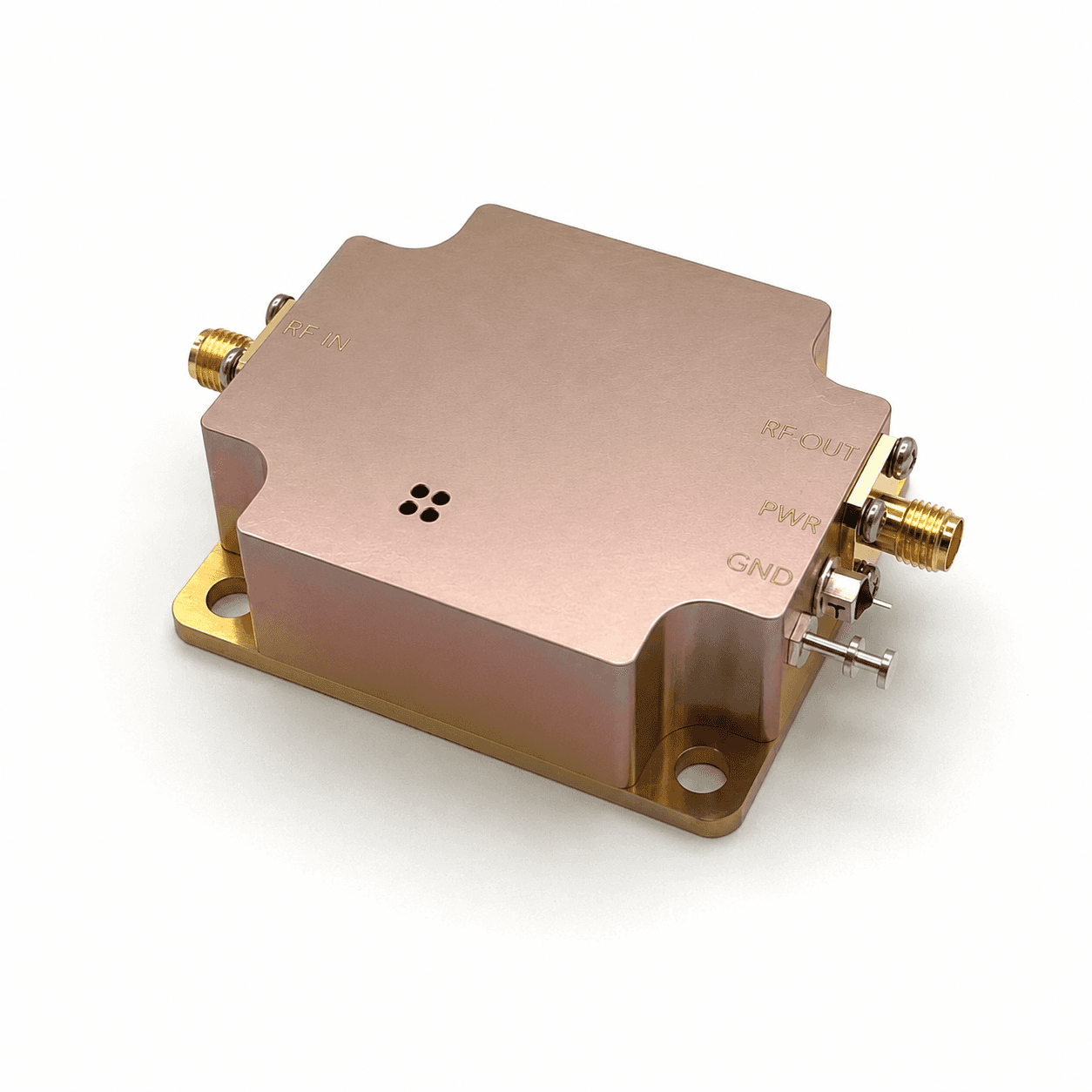
LNA-S-002 is a COTS integrated low-noise amplifier and cavity filter module covering 2025 to 2120 MHz for spacecraft TT&C receive chains, in the most compact package in this range at 90 g. Gain is 30 dB typical at 2.5 dB noise figure, and out-of-band input 1 dB compression is +36 dBm, giving substantial headroom against a strong interferer. TRL 9, radiation tolerant to 500 krad(Si), qualified to NASA GEVS.
LNA-S-002 is a COTS integrated low-noise amplifier and cavity filter module covering 2025 to 2120 MHz for spacecraft TT&C receive chains, in the most compact package in this range at 90 g. Gain is 30 dB typical at 2.5 dB noise figure, and out-of-band input 1 dB compression is +36 dBm, giving substantial headroom against a strong interferer. TRL 9, radiation tolerant to 500 krad(Si), qualified to NASA GEVS.
PRODUCT OVERVIEW
Placing the cavity filter ahead of the amplifier lifts the out-of-band 1 dB compression point to +36 dBm typical, against -10 dB in band, which is what keeps a TT&C receiver operating when the spacecraft's own transmitter or a neighbouring payload is radiating hard. Gain is 28 to 34 dB with 30 dB typical, noise figure is 2.5 dB typical and 3.5 dB maximum, and rejection at 2200 MHz is 60 dBc typical. Supply is 4.5 to 12 VDC at 50 to 60 mA through a DC feedthrough, with RF on SMA female. The module is 61 x 51 x 19 mm (2.4 x 2.0 x 0.75 in) at 90 g. Built for the harsh conditions of space, the sealed and vented housing is rated for a five-year LEO mission life. Qualification follows NASA GEVS (GSFC-STD-7000) with random vibration to 14.1 GRMS and humidity per MIL-STD-810 Method 507.6, across a -70 to +100 °C operating and storage range. Radiation tolerance is 500 krad(Si) with no destructive single event effects observed to 37 MeV-cm²/mg. CSA-S-001-RH and CSA-S-003-RH are the associated antennas.
Placing the cavity filter ahead of the amplifier lifts the out-of-band 1 dB compression point to +36 dBm typical, against -10 dB in band, which is what keeps a TT&C receiver operating when the spacecraft's own transmitter or a neighbouring payload is radiating hard. Gain is 28 to 34 dB with 30 dB typical, noise figure is 2.5 dB typical and 3.5 dB maximum, and rejection at 2200 MHz is 60 dBc typical. Supply is 4.5 to 12 VDC at 50 to 60 mA through a DC feedthrough, with RF on SMA female. The module is 61 x 51 x 19 mm (2.4 x 2.0 x 0.75 in) at 90 g. Built for the harsh conditions of space, the sealed and vented housing is rated for a five-year LEO mission life. Qualification follows NASA GEVS (GSFC-STD-7000) with random vibration to 14.1 GRMS and humidity per MIL-STD-810 Method 507.6, across a -70 to +100 °C operating and storage range. Radiation tolerance is 500 krad(Si) with no destructive single event effects observed to 37 MeV-cm²/mg. CSA-S-001-RH and CSA-S-003-RH are the associated antennas.
TECHNICAL SPECIFICATIONS
RF PERFORMANCE
FREQUENCY RANGE
2025-2120 MHz
GAIN
30 dB
NOISE FIGURE
2.5 dB
INTEGRATION & QUALIFICATION
APPLICATION
TT&C Receive
TRL
TRL 9
RF CONNECTOR
SMA female
VOLTAGE
4.5-12 VDC
CURRENT
50 mA
OPERATING TEMPERATURE
-70 to +100 °C
HUMIDITY
65% (MIL-STD-810 Method 507.6)
VIBRATION
14.1 GRMS random (GSFC-STD-7000)
SHOCK
RADIATION HARDNESS (TID)
500 krad(Si)
SEE
37 MeV-cm²/mg
MASS
90 g